The Greenway's grass trails still run between the Jasmine Street gate and the Sadler Road boardwalk, as the city describes them. The Greenway they pass through is nearly ten acres larger. In early October, the City of Fernandina Beach and North Florida Land Trust completed two acquisitions along Egans Creek. One was a donation and the other a discounted sale, and the city now owns and manages both.
The Ron Sapp Egans Creek Greenway, already more than 300 acres with mapped trails and a pavilion at Atlantic Avenue, is still growing. The new parcels are the first two of five that the city and the land trust are working to protect. The way they came together, with a public conservation fund, a land trust's island fund and landowners willing to part with their property for less than market value, is close to how the Greenway was put together in the first place.
Two parcels, two ways of giving land
North Florida Land Trust announced the completed acquisitions on Monday, Oct. 5. The two pieces differ in size and in how they changed hands.
| Quattlebaum parcel | Pineland parcel | |
|---|---|---|
| Size | Nearly 9 acres | About 1 acre |
| Land type | Wetlands buffering Egans Creek | Uplands with Sadler Road frontage |
| How acquired | Donated by Sherry Quattlebaum | Sold at a conservation discount by Pineland Holding Company, LLC, owned by John Adler |
| Owner and manager | City of Fernandina Beach | City of Fernandina Beach |
The larger piece came as a gift. Quattlebaum, who worked as a schoolteacher and a real estate professional, bought the wetland parcel in the early 2000s, around the time the Greenway itself opened. She told the Amelia Island Signal that she donated it through the land trust so it would stay natural and serve as an amenity for Fernandina Beach residents.
"The land is located within an area that is also a wildlife corridor, and my hope was it would become a continuation of the greenway."
The smaller piece fronts Sadler Road, the busy corridor at the Greenway's southern trailhead. Nassau NewsLine mapped its location in its own report on the additions. Adler sold it below market for conservation, and the purchase drew on city funding, a large gift from a private Amelia Island donor and the land trust's Amelia Forever Fund.
Deed restrictions now limit both properties to nature-based recreation, passive parks or open space. Those are the same uses that define the rest of the Greenway.
Twenty-eight acres in view
The two parcels did not come out of nowhere. On Sept. 2, the Fernandina Beach City Commission voted 4-0 to renew its memorandum of understanding with North Florida Land Trust, as the Fernandina Observer reported. Under the agreement, both partners help pay for conservation purchases they pick together. The October acquisitions were the first completed under it.
The broader plan targets five parcels totaling about 28 acres. With two done, three remain pending. Measured against the full target, the nearly ten acres added so far come to roughly a third of the land in play. The money set aside for the effort breaks down this way:
- City of Fernandina Beach: up to $240,000 from its Land Conservation Trust Fund, approved at the Sept. 2 meeting
- North Florida Land Trust: approximately $500,000 from the Amelia Forever Fund, which the land trust set up in 2019 to acquire remaining natural spaces on Amelia Island
- Private gifts: the large donation toward the Pineland purchase, along with Quattlebaum's donated wetland
The land trust's capacity in the county grew at about the same time. On Sept. 7, five days after the commission vote, North Florida Land Trust announced a $1 million anonymous donation restricted to conservation in Nassau County, which Action News Jax reported first.
Allison DeFoor, the land trust's president and CEO, said the new parcels strengthen a wildlife corridor along Egans Creek that development has not broken up, and that the land will stay natural permanently. City Manager Sarah Campbell called the Quattlebaum donation a gift that will benefit generations of residents. In the Signal's account, Commissioner Joyce Tuten, who lives next to the Greenway, spoke about how much undeveloped land matters to the island's long-term livability.
The same method that built the Greenway
None of this is a new way of adding parkland in Fernandina Beach. According to the city, the Greenway opened in 2000 as an undeveloped park for conservation and passive recreation, with land bought using money from the Florida Communities Trust and the City of Fernandina Beach. That pairing of state conservation dollars and local funds is close to this fall's mix of city trust-fund money and land trust dollars.
The name on the Greenway comes from that early period. The News-Leader describes Ron Sapp as a teacher, city official and community leader who helped bring about the Greenway and the city's open-space bond, which voters approved in 2001 with 52 percent. The bond passed narrowly, and the corridor it helped protect is still being added to a quarter century later, one willing landowner at a time.
Quattlebaum's parcel shows how that works. She bought it in the early 2000s, kept it for about two decades, and gave it to the city in 2026 so that it would continue the Greenway.
Walking the Greenway this season
Until the city decides how the new parcels will be used, the Greenway on foot is the one already mapped. No timeline has been set for trail access or improvements on the new land.
The mapped Greenway has two distinct halves, and each suits a different kind of outing.
North of Jasmine Street
Between Jasmine Street and Atlantic Avenue, the city's brochure describes saltmarsh and maritime forest. This is the stretch for wading birds: herons, egrets, wood storks and, in season, roseate spoonbills. Two bridges cross the creek to the west at the ends of Hickory and Beech Streets, and a wildlife viewing platform looks over the saltmarsh near Atlantic Avenue. The Atlantic Avenue entrance has the nature pavilion, a picnic area and the Greenway's restroom.
South to Sadler Road
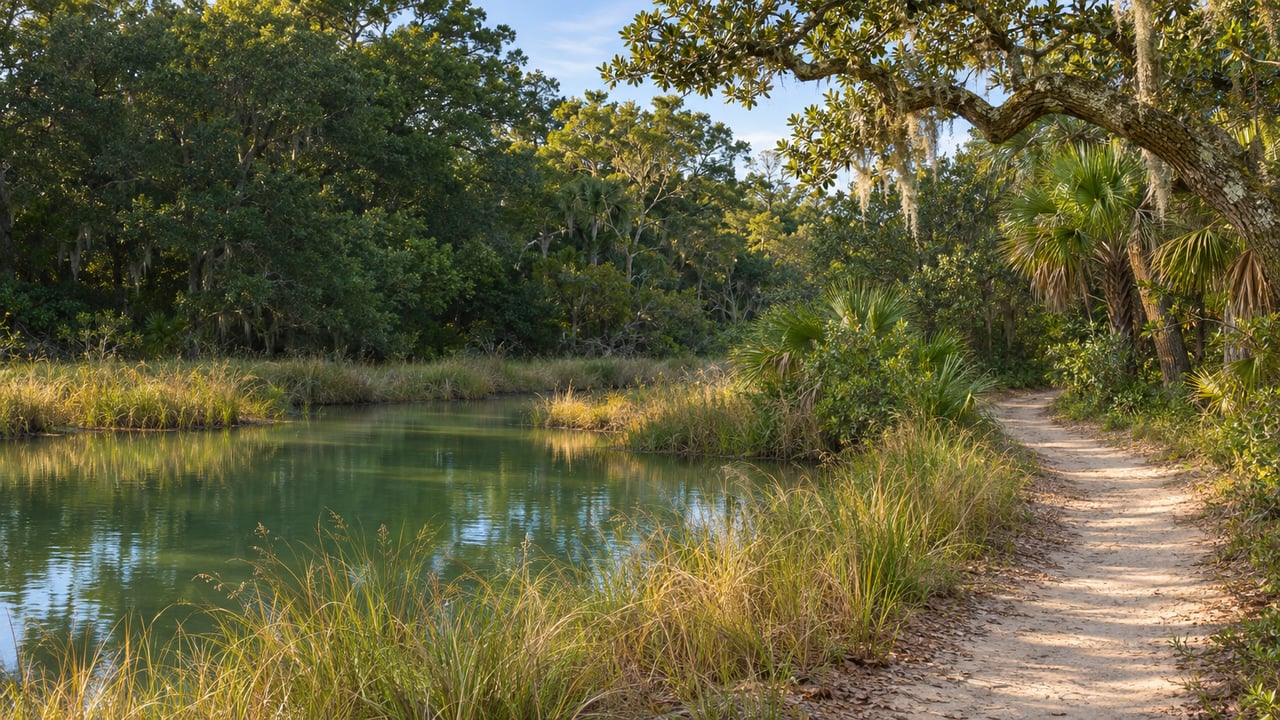
Between Jasmine Street and Sadler Road, the Greenway becomes a more forested freshwater system. Egans Creek runs along the east side, with water-filled ditches crossing the interior. You can enter or leave this section at Jasmine Street or by the raised boardwalk at the Sadler Road trailhead, the end of the Greenway nearest the new one-acre parcel. For a city ecotour this year, the city listed 2555 Jasmine St. as the closest address and directed visitors to park near the north Jasmine entry gate.
The trails throughout are grass-covered and suited to walking and biking. Alligators, marsh rabbits and many bird species live along the creek, and the city asks visitors to watch them from a distance.
The city's posted rules for the Greenway include:
- Open sunrise to sunset, with no overnight use.
- Dogs welcome on a leash and under control, with waste picked up.
- No motorized vehicles, fireworks, alcohol or fires.
- Fishing allowed from the bridges with the required shoreline fishing license, with lines and traps attended and never tied to the bridges.
- Stay on mapped trails, and do not approach, chase or feed wildlife.
Group tours for hire need approval from the Parks and Recreation Department, which schedules them at 904-310-3350, extension 1. The city's Greenway brochure has the full list of rules.
The city now owns the nearly nine acres of creekside wetland and the acre along Sadler Road, and three more parcels in the 28-acre plan are still pending.
At The Landings on Amelia River, we live with marsh, creek and sky every day, and we follow the island's conservation work closely. If you would like to see how our west-shore setting sits within that same natural corridor, we would be glad to show you. Schedule a Private Tour.